It began publicly trading on Dec 12, 1980 and this is the fifth split. Here is a history of Apple's previous splits and its after effects. As noted above, stock splits should have, technically, no impact whatsoever on market values of the companies involved. The price of the shares is cut in half, and the number of shares doubles. The operations of the company (e.g., its sales and earnings) are unaffected, and the market cap should not change. This is Apple's fifth stock split since it went public on December 12, 1980, at $22.00 per share.
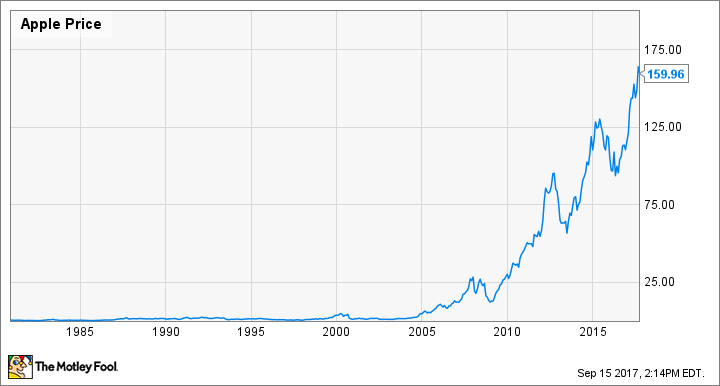
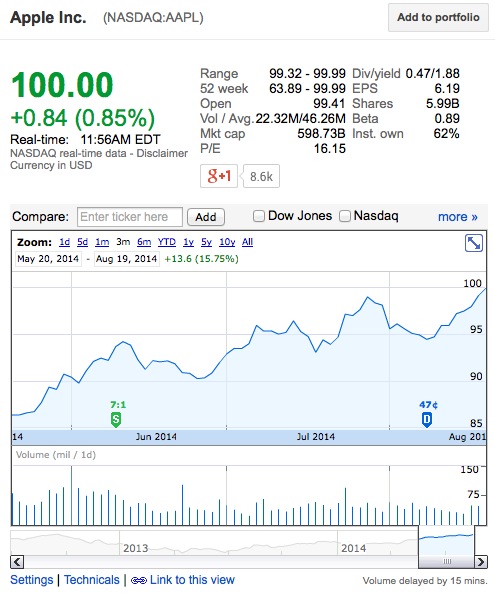
The stock has split four times since the IPO so on a split-adjusted basis, the IPO share price was $0.39. In June 2014, following a seven-for-one stock split, Apple shares were trading at $94. Nothing fundamentally changes with a company when it splits its stock; its market capitalization remains the same, too. Companies usually split their stocks in an effort to make their share prices more attractive to individual investors, who may be put off by a too-high stock price. But in today's market, splits seem unnecessary, says Morningstar senior editor Ruth Saldanha.

Apple's fourth and final stock split to date happened on 9 June 2014. This was the most significant of Apple's stock splits, with a seven-to-one ratio taking shares from close to $700 down to around $100. Apple wanted to make shares accessible to more investors, but it's also speculated that they set their sights on inclusion in the Dow Jones Industrial Average index. This index acts as a benchmark, with 30 stocks included from key economic sectors. As it's a price weighted average, Apple's stock price needed to be reduced before it was feasible for the company to be added.

It was announced that Apple would join the Dow Jones in March 2015 and it has been a part of the index since March 2019. The second Apple stock split took place on 21 June 2000, and was also a two-for-one split. Shortly afterwards though, in September 2000, share prices were halved as many technology companies experienced a rapid decline. This was around the time the dot-com bubble burst, where many companies went out of business and others decreased in value.

Apple blamed lower-than-forecast sales, as well as a weaknesses in the education market. While Apple was affected temporarily, the company's shares made a full recovery and went on to achieve new highs. Apple's stock split process began after the closing bell on Monday, August 24. On that day, the company makes a record of shareholders on record whose stocks will be split.

Investors on record will receive their additional shares after the closing bell on August 28, and shares will begin trading at the new split-adjusted price on August 31. Companies may go through reverse stock splits to avoid being delisted from a stock exchange if they're nearing the minimum share price allowed on that exchange. They also might do a reverse stock split to improve the company's public image or draw attention from high-profile investors or analysts.

Apple's stock split process begins today after the closing bell. The company will make a record of current shareholders whose stocks will be split. Current investors will receive their additional shares after the closing bell on August 28, and shares will begin trading at the new, split-adjusted price on August 31.
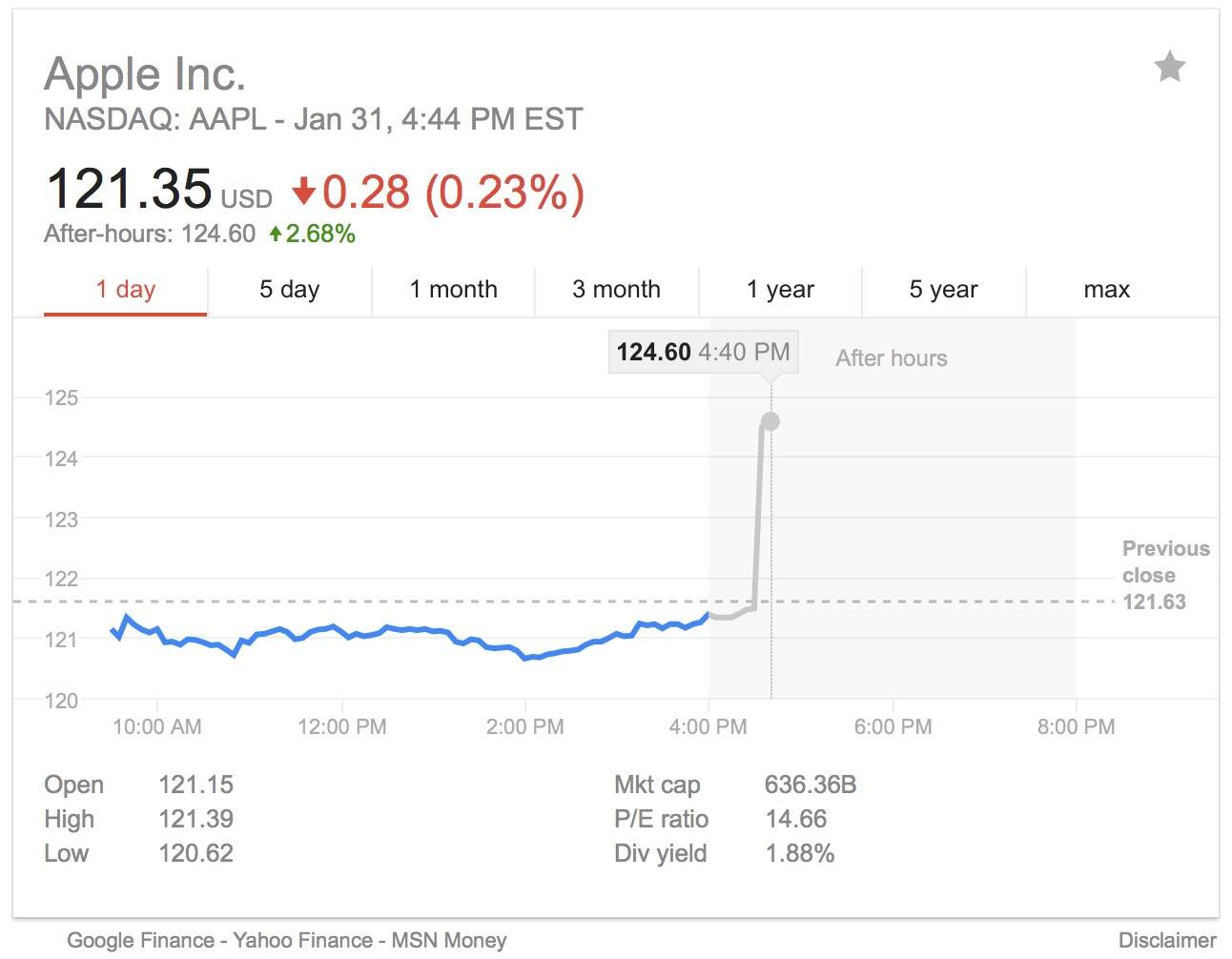
When looking at the value of a company's shares, it can be difficult to interpret how successful the company has been based on its stock prices following a split. Apple's current share price of around $408 doesn't look as impressive as it would have done ahead of its four stock splits. Apple stock has been on a steady climb since March, becoming the most valuable company in the world following its record-breaking third-quarter earnings. On Monday, Apple stock rose to an all-time high of $505 ahead of its stock split, which is meant to make it easier for more investors to own Apple shares.

The stock split applies to shareholders on record as at August 24, 2020 , the share gets split on Friday, August 28, and trading under the split shares starts on Monday 31st August. The stock will undergo a 4-for-1 stock split for those shareholders of record on August 24, 2020. This means for each share of AAPL held; you will receive three additional shares, while the share price of the stock will be quartered. The shares will undergo the "split" after the market closes on August 28 and officially begin trading with the new share price on August 31. SOPA Images/LightRocket via Getty Images Apple AAPL did something very unusual in July.

That is to say, if you owned a share of Apple, the company in effect now issued you three additional shares. The total number of Apple shares outstanding increased by a factor of 4, and the market re-set the share price at one quarter of its previous level. The maneuver left the value of your holdings, and the value of the company in the market, unchanged . To be clear, stock splits do not change a company's underlying fundamentals.

And though the lower-priced shares can attract smaller investors, larger investors already trading the shares can maintain more influence over the price action. The overall market environment is key, as well, and it has influenced trading after the limited number of previous Apple stock splits. Already plumped up by giant rallies in 2020, both stocks popped again Monday, supassing record highs after the corporate actions took effect. Apple's 4 for 1 stock split has taken effect as of Monday, August 31 and analysts are weighing in on how the move will impact the stock's share price.

While historically AAPL has seen on average a 10.4% increase 12 months after its stock splits, there are a couple of factors that could hint at stronger than average gains for Apple shares this time around. A stock split is a corporate action that companies take to increase the number of outstanding shares and decrease the value of each share. In other words, as a company's stock price increases, investors are rewarded with higher returns. But eventually, the stock may reach a price that makes it difficult for new investors to jump in, which is when the stock split comes in. Apple's first stock split occurred on 16 June 1987, seven years after it became a public company, and it was a two-for-one stock split. It kept share prices low enough to make them accessible to investors.

There was a 2% rise in stock prices over the following year. An investor buys a share in Apple in January 2005, so they have one share worth $77.00. After the two-for-one stock split a month later, they own two shares in Apple, but each of these shares is worth half the amount, at $38.50.

What Was The Price Of Apple Stock After The Split If the shareholder keeps these two stocks until May 2014, they will be worth $1,266 ($633 each) as the stock price appreciates. With the fourth stock split, each of these stocks will then be split seven times, so that the shareholder owns 14 shares in Apple. If you had spent $1,000 on Apple stock in 1980, you would have been able to buy about 45 shares at $22 apiece. Apple shares have split four times since then—when a stock splits, it increases the number of shares an individual has—which puts the adjusted initial offering price at closer to 39 cents a share. Using that figure, an investment of $1,000 in Apple back in 1980 would yield close to $272,000 today. Investing in certain instruments, including stocks, options, futures, foreign currencies, and bonds involve a high level of risk.

You must be aware of these risks before opening an account to trade. The income you may get from online investing may go down as well as up. Apple has undergone four previous stock splits in its 40-year history on the stock market, with prices rising 10% on average in a year. Following its 2005 stock split, Apple shares jumped 58%, and then 36% after its 2014 split.
This is where split adjusted figures come in – they account for stock splits when working out return on investment. With Apple, stock adjusted figures would acknowledge the fact that one stock bought during its initial public offering would now have become 56 shares. It began trading publicly on Dec. 12, 1980, and this is the fifth split.

The most recent one adjusted its share price from about $500 to $125. While one share at $500 is the same investment amount as four shares at $125, Apple executives believed the split would make the stock "more accessible to a broader base of investors." After Friday's closing bell, Apple shareholders are due the split shares for each existing share of the company that they own. This is applicable for those who were shareholders of record by Aug. 24, though Apple said that those who bought shares between the record date and the time of Friday's split would also be issued split shares. Apple shares officially start trading at the new split-adjusted price at the opening bell of Monday's Nasdaq session. Apple announced its plan for the split on July 30 with its most recent earnings report.
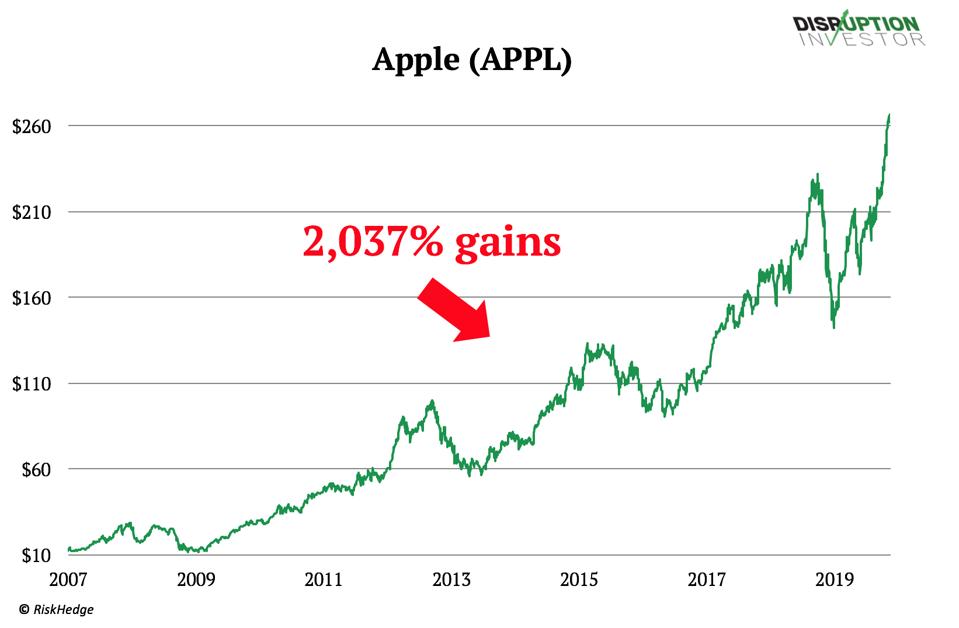
Apple's financial performance, including its share price, relies heavily on the sales of its products. A high flier through much of its recent history, Apple stock hit new all-time highs toward the end of 2021, with a market capitalization approaching a record $3 trillion. Apple is having a great year, and its4-for-1 stock spliton Monday is expected to make the market's most-valuable company even more attractive to a wider universe of retail investors.

But the limited history of Apple stock splits says there is no reason to rush in to buy the lower-priced shares. Silverblatt said companies traditionally courted more retail investors because they were loyal "buy and hold forever" types – which can lend stability to share prices. If that's Apple's strategy, the company is hoping the 4-for-1 split at the end of the month will put a solid floor under its shares at around $100 that would lock in shareholder gains in 2020. Of course it's tricky to measure how much of an impact the stock split itself had on prices compared to other factors. When Apple split stocks in 2000, its share price was 60% down 12 months later thanks to the dot-com crash. And because companies usually split stocks when they're performing well, there may be a whole host of reasons why prices continue to go up in the near future.

Apple briefly became the world's first $3 trillion company today based on market capitalization, which is the total value of all of the company's outstanding shares. The milestone came after Apple's stock price rose over 40% in the last year. The impressive feat, which Apple achieved when its stock price reached the $182.86 mark during intraday trading, came just over 16 months after Apple be...
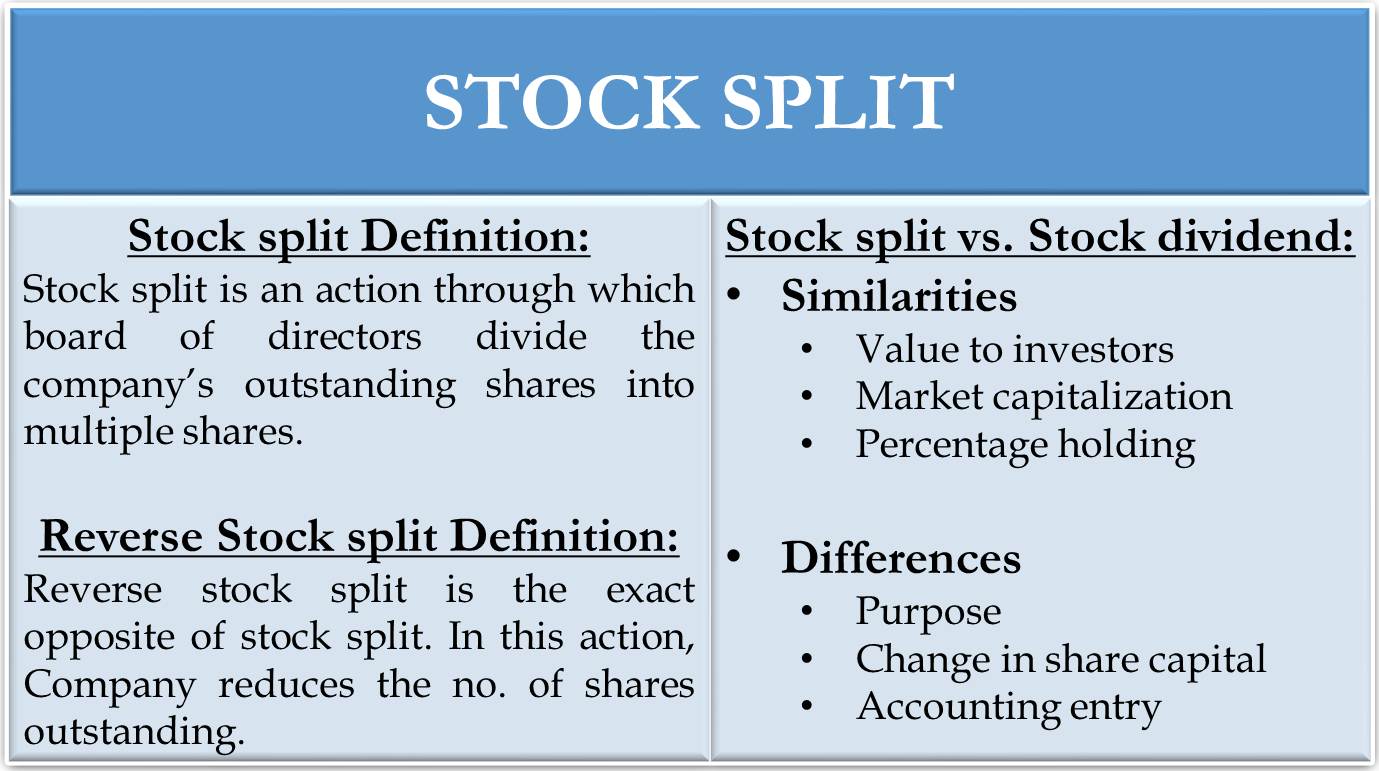
And while stock splits can increase a stock's liquidity and make it more accessible for investors, not all companies engage in them. According to Railey, some companies prefer to keep their stock prices high. A stock split allows a company to break each existing share into multiple new shares without affecting its market capitalization or each investor's stake in the company. A stock split can be a good sign for both current and prospective shareholders.

Certainly, all kind of factors can influence a company's performance, be it market crash or a new product launch and stock split is also one of those factors. They create short term blips but they cannot create long term effect and revenue or good profit margins can only push stock in long term. Apple has been a massive winner for patient investors because the company has strong leadership and is continually innovating.

Investors who bought after the COVID pandemic induced downfall, they have been rewarded handsomely. History has been repeated for Apple stock as similar kind of saga unfolded after 2000 dot com induced crash. In the quarter following the split, shares were up three out of five times. In 2000 and 1987, stock climbed more than 20%, eluding market collapses that were about to come. In contrast, quarters in 2020, 2014 and 2005 were decently bad, but stock was about to give good return in a matter of time.

It seems unlikely that Apple will complete another stock divide in the near future. Share prices are still climbing (they are currently trading at around $186), however shares were worth close to $700 before the last split in 2014. Apple may consider another stock split if share prices continue to rise, but for now, this move probably wouldn't be in the best interests of the company. While a stock split might be carried out to encourage investment, the split in itself doesn't affect the market capitalisation of a company. Existing shareholders will own more stocks, but each of those stocks is worth less, so there is no change to the total market value of the company.
A stock split is one of many 'corporate actions' taken by big companies. A corporate action is anything that changes the share of capital or voting rights held by a company's shareholders. Others include mergers, takeovers, dividend adjustments, and issuing more shares. Assuming that as of the Record Date you own 100 shares of Apple common stock and that the market price of Apple stock is $400 per share so that the investment in Apple is worth $40,000. Let's also assume that Apple's stock price doesn't move up or down between the Record Date and the time the split actually takes place .
Reverse stock splits are rarely beneficial for shareholders because the stock price starts off at a higher price and you have fewer shares, making it more difficult to re-balance your portfolio. In all likelihood, the stock price will continue to decline after a reverse split. In Citigroup's case, the stock continued to decline after the split and has yet to recover.

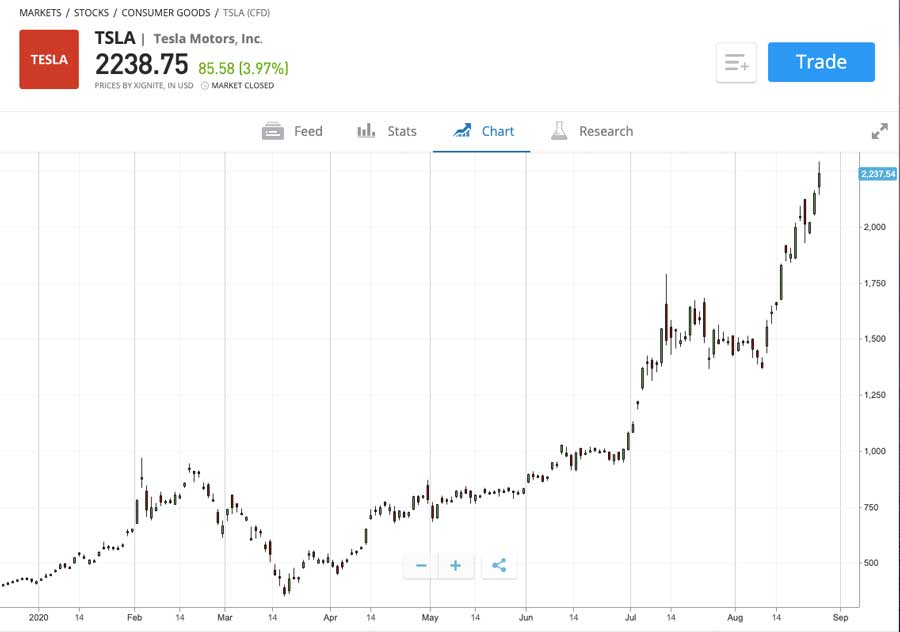
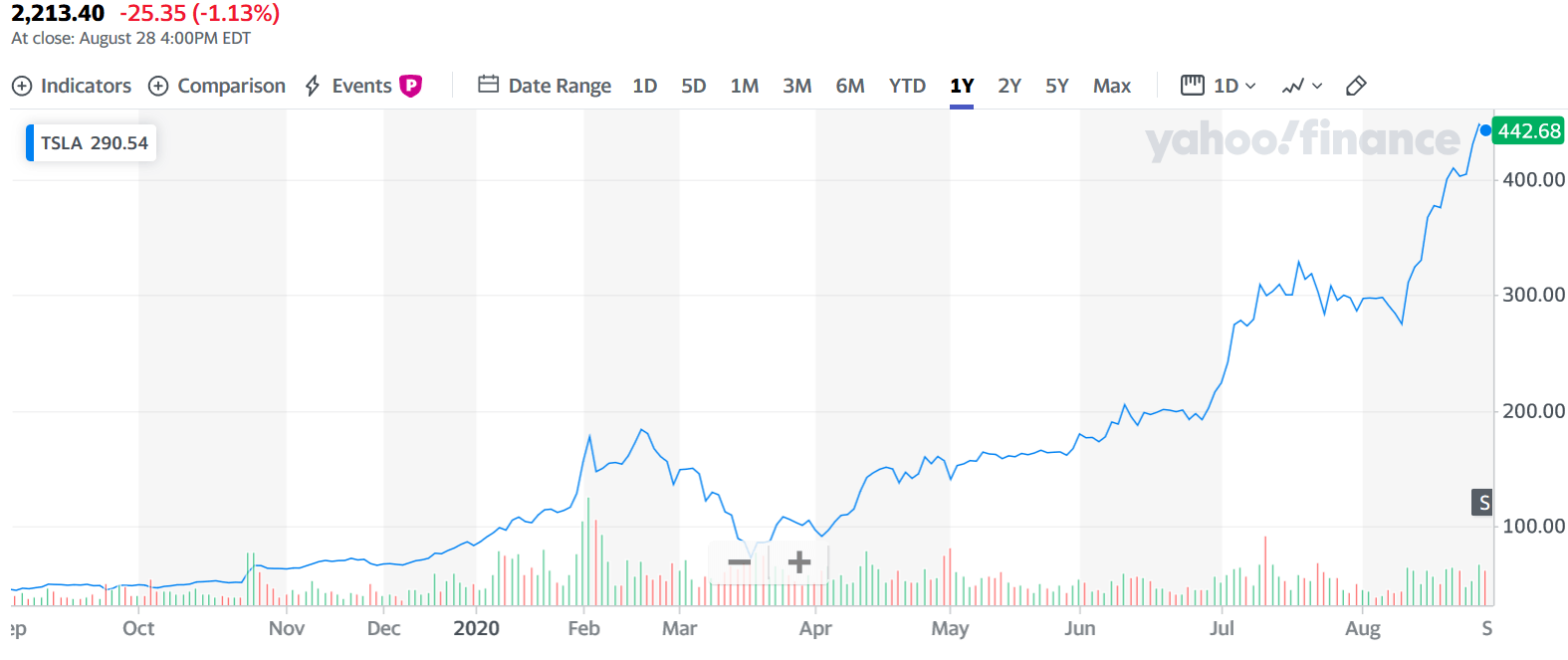
Apple has rallied the most in the Dow this year as locked-down consumers snapped up new iPhones, iPads and Mac computers to stay connected during the pandemic. A stock split is where one stock is divided into several stocks along with its share price. As Tesla had a 5-for-1 stock split, one stock became five at one-fifth of the price, while Apple split its stock 4-four-1, with one stock divided into four. It doesn't change the value of the stock or the company, it just means there are more shares circulating the market at a lower purchase price. We sell different types of products and services to both investment professionals and individual investors.
These products and services are usually sold through license agreements or subscriptions. Our investment management business generates asset-based fees, which are calculated as a percentage of assets under management. We also sell both admissions and sponsorship packages for our investment conferences and advertising on our websites and newsletters. If you own Apple stock, you will not see a change in the value of your investment in the company after the split.

You will have more shares in your account, but the AAPL stock price will be proportionately lower. The split itself will also not impact the S&P 500 Index because the market value of AAPL is not changing with the split. On the other hand, the Dow Jones Index will see a significant change due to Apple's share price decreasing after the split since it is a price-weighted index. To determine a stock's influence on the S&P 500, you first need to calculate each company's market cap in the index. A simple way to do this is to multiply the number of shares outstanding by the price of each share. Then you add all of those market caps together to get the total market cap of the S&P 500.

Finally, divide each company into the total market cap of the index to get the weighted average. Thus, the larger the market cap of a company in the index, the more impact each 1% change in the stock price will have on the index. Keep reading to learn how stock splits work, how it affects you as a shareholder, and whether it's worth investing in a company after a stock split. For options, there's the Options Clearing Corporation , which is the central clearer for all options listed in the United States. Its Securities Committee, along with an "adjustment panel" made up of representatives from exchanges, decides whether an adjustment is needed and how it should be structured.


